
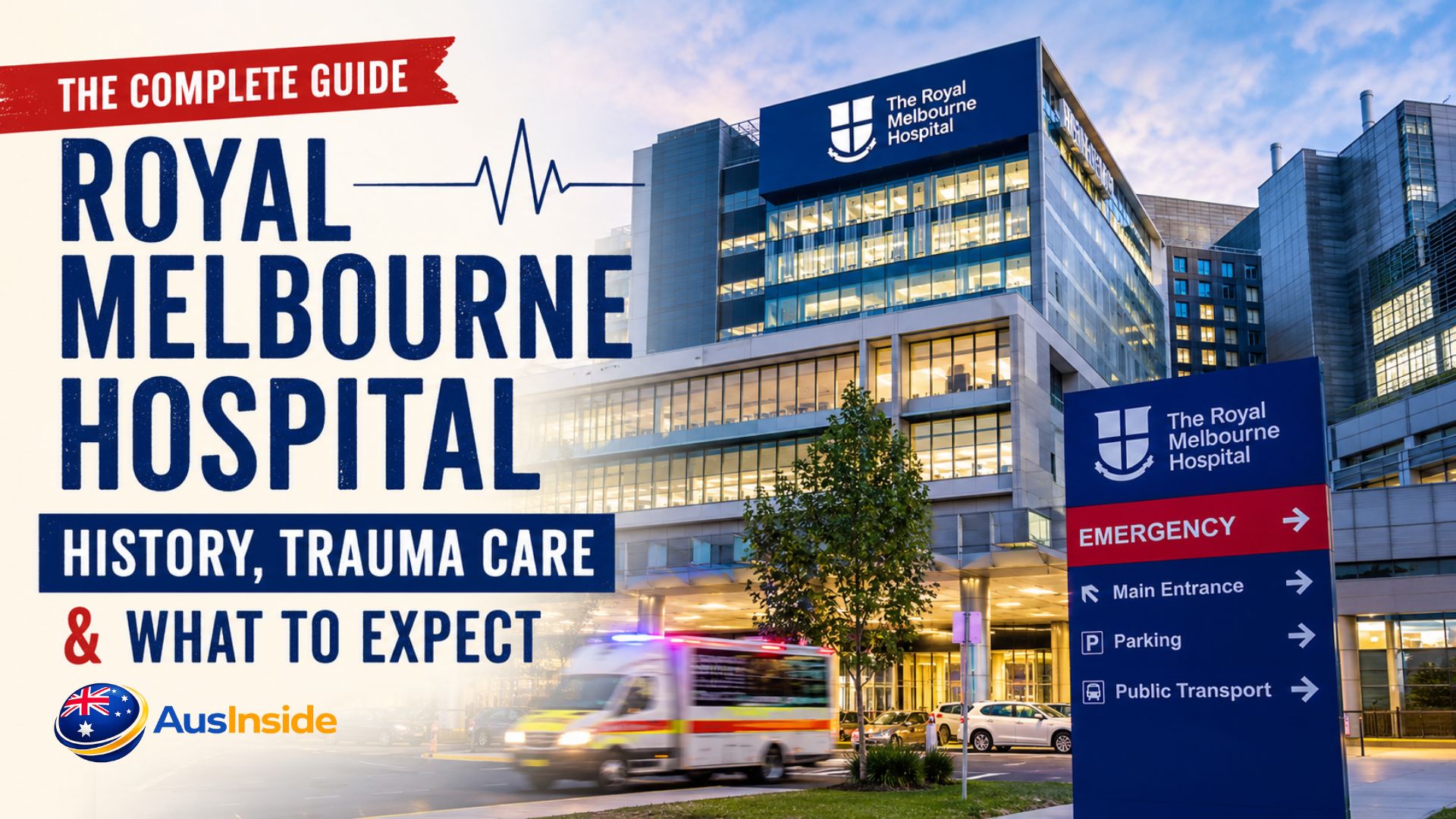
There’s a moment that happened on a Friday in January 2020 that almost nobody outside Melbourne knows took place at this hospital. A patient sample arrived at a lab inside the Royal Melbourne Hospital, and within days, a small team had grown the COVID-19 virus in culture — the first time anyone outside China had managed it. That breakthrough reshaped how the entire world tested for the virus. It happened here, quietly, in a building most people only think about when an ambulance is involved.
That’s the thing about the RMH. It’s simultaneously one of the most written-about hospitals in Victoria and one of the least understood. Most articles either drown you in generic visiting-hours copy or read like a Wikipedia stub with the personality surgically removed. Neither tells you what actually makes this place different — why it predates the state of Victoria itself, why its emergency department publishes live wait times in a way almost no other Australian hospital does, or why a 178-year-old institution keeps showing up at the centre of national health crises.
This guide covers all of it: the real history, what “Level 1 trauma centre” actually means for a patient, the live data tools most visitors never find, and the practical details — locations, parking, visiting rules — you need if you or someone you love ends up here. Information changes, so where it matters, we’ll point you to where to verify it yourself.
Have A Look On It: The Alfred Hospital
- Quick Facts: Royal Melbourne Hospital at a Glance
- A Hospital Older Than the State It Sits In
- What the RMH Actually Treats and What It Doesn't
- Inside the Trauma Service: What "Level 1" Actually Means
- The Live Wait-Time Dashboard Almost Nobody Knows Exists
- The Hospital's Three Sites — and Why Mixing Them Up Matters
- Visiting the RMH: Hours, Rules, and the Details That Trip People Up
- Getting There: Parking, Transport, and the Things Google Maps Won't Tell You
- All Research at the RMH: The Story Most Person Don't Tell You
- Mistakes People Commonly Make About the RMH
- Key Takeaways
- FAQs
Quick Facts: Royal Melbourne Hospital at a Glance
| Detail | Information |
| Founded | 1846 (foundation stone laid), opened 1848 |
| Original name | The Melbourne Hospital |
| Royal Charter granted | 27 March 1935 |
| Main campus | 300 Grattan Street, Parkville, VIC 3050 |
| Hospital type | Public tertiary teaching hospital |
| Beds (Parkville) | Approximately 570 |
| Trauma status | Level 1 Major Trauma Centre — one of only two adult centres in Victoria |
| Trauma patients/year | Around 5,000, with 1,000+ classified as major trauma |
| University partner | University of Melbourne |
| Royal Patron | King Charles III |
| Live ED wait-time data | Yes — public dashboard, updated regularly |
| Switchboard | (03) 9342 7000 |
A Hospital Older Than the State It Sits In
Here’s a fact that genuinely surprises most Melburnians: the Royal Melbourne Hospital is older than Victoria itself. The foundation stone was laid on 20 March 1846, and the hospital opened in 1848 — three years before Victoria separated from New South Wales as its own colony in 1851. It also predates the University of Melbourne and the State Library of Victoria, both founded in 1854.
It started small. Almost absurdly small, by today’s standards. The original Melbourne Hospital was a 10-bed, two-storey cottage on the corner of Lonsdale and Swanston Streets, run as a charity for the poor and funded entirely by subscribers and donors — the British voluntary hospital model transplanted to a goldfields colony. There was no government funding, no Medicare, nothing guaranteeing it would survive its first decade. It did, and it kept growing.
From Lonsdale Street to Parkville
The hospital outgrew that cottage and was rebuilt on the same Lonsdale Street site decades later. A trust contributed £120,000 toward the rebuild, the new foundation stone was laid on 23 March 1912, and the rebuilt hospital opened on 22 July 1913 — this time with four operating theatres, electric lifts, and X-ray equipment, genuinely cutting-edge for the era.
The final move came in 1944, when the hospital relocated to its current Parkville site. There’s an odd wartime detail buried in that timeline: the Parkville building had actually opened in 1940, but it spent its first four years as a US armed forces military hospital before the RMH itself moved in. And the old Lonsdale Street site wasn’t bulldozed into nothing — remnants of the original buildings still exist today, tucked inside what is now the QV shopping and retail centre in the CBD. Most people walking past those shops have no idea they’re standing near the hospital’s original footprint.
Why “Royal”?
It operated for almost 90 years as plain “the Melbourne Hospital” before earning its Royal Charter on 27 March 1935. That’s the entire source of the name — not a funding model, not private ownership, just a formal royal designation granted nearly a century after the hospital first opened. King Charles III now holds the role of Royal Patron, continuing an association that’s outlasted several monarchs.
The Nurse Who Built the Hospital’s Backbone
If one person shaped the RMH’s professional identity more than any surgeon, it was Jane Bell. She left the Edinburgh Royal Infirmary in 1910 to become the hospital’s Lady Superintendent of Nursing and held the role until 1934, establishing a new standard of nursing administration in Australia. Under her tenure came a string of quiet but foundational firsts: a Theatre Sister appointed in 1912, a Sister Tutor in 1921, a Preliminary Training School for Nurses in 1927, and a dedicated diet kitchen in 1929. None of these sound dramatic individually. Together, they represent the moment Australian nursing shifted from informal trade to structured profession — and it happened largely inside this building.
Google Map View
What the RMH Actually Treats and What It Doesn’t
The RMH is a public tertiary teaching hospital, and that phrase carries real weight once you unpack it:
- Public — Medicare-funded, free at the point of care for eligible patients.
- Tertiary — equipped for the most complex cases, including those too severe for smaller hospitals to manage.
- Teaching — formally affiliated with the University of Melbourne, training doctors, nurses, and allied health staff on-site.
That combination supports a genuinely enormous service load: more than 120 distinct services and over 350 specialist clinics, delivered across two hospital sites, 50-plus community locations, and patients’ own homes.
What it covers
- Cardiology and cardiovascular disease
- Major trauma and emergency medicine
- Neurology and stroke care
- Intensive care
- Kidney care and dialysis
- Oncology
- Mental health services
- Victorian Infectious Diseases Service
- Victorian Tuberculosis Program
- Medical imaging
What it deliberately doesn’t cover
This is the part most articles skip entirely, and it causes real confusion. The RMH is a general hospital that covers nearly every field except maternity and standard paediatrics. If you’re pregnant or bringing in a young child, you’ll be redirected to the neighbouring Royal Women’s Hospital or Royal Children’s Hospital — both sit in the same Parkville precinct, so the redirect is usually just a short walk, not a citywide trek. Knowing this in advance saves a stressful, unnecessary trip to the wrong building.
Inside the Trauma Service: What “Level 1” Actually Means
Victoria’s trauma system runs on tiers, and Level 1 sits at the very top. It means a hospital is equipped to manage the most severe, multi-system injuries without needing to transfer the patient elsewhere for definitive care.
The RMH is one of only three major trauma centres in Victoria, and one of just two that treat adults — the other being the Alfred Hospital. (The third centre, the Royal Children’s Hospital, handles paediatric trauma.) The RMH was the first hospital in the entire Victorian State Trauma System to achieve formal Level 1 Trauma Verification from the Royal Australasian College of Surgeons, in 2012. That verification isn’t a permanent badge — hospitals have to maintain it through ongoing standards around staffing, response times, and clinical outcomes.
The numbers behind the headline
The trauma service treats around 5,000 patients a year, with more than 1,000 classified as major trauma — injuries severe enough to involve internal bleeding, brain trauma, spinal injuries, or multiple broken bones. Care runs 24/7, covering everything from motor vehicle crashes and workplace incidents to falls, assaults, and water sports injuries.
The emergency department itself is sized for that load. It’s one of the largest in Victoria, with 2 dedicated trauma bays, 6 resuscitation cubicles, 25 general cubicle beds, and 17 short-stay beds. A rooftop helipad lets regional trauma cases get airlifted straight in, skipping the delay of a road handoff between a regional airstrip and the hospital.
A trauma registry going back three decades
One detail almost no competing article mentions: the Royal Melbourne Trauma Registry has been running since January 1996 and now holds records on more than 15,800 trauma patients. That’s nearly thirty years of consistent data on every trauma admission, transfer, and in-department death meeting the registry’s criteria. Few hospitals anywhere maintain a dataset that long and that clean — it’s a major reason the trauma team can keep refining protocols based on real outcomes instead of guesswork.
The Live Wait-Time Dashboard Almost Nobody Knows Exists
This is the single most useful tool on the RMH website, and it’s almost never mentioned in articles about the hospital. In mid-2025, the RMH launched a public Emergency Department wait-time dashboard that shows, in close to real time, how long non-urgent patients can expect to wait between triage assessment and seeing a doctor.
As of recent readings, the dashboard has shown figures like a 57-minute to 2-hour-17-minute estimated wait, alongside a live count of patients currently waiting and patients currently being treated. It updates regularly through the day. The hospital is explicit that the number of people sitting in the waiting room isn’t a reliable indicator of how busy the department actually is, since a meaningful share of patients arrive by ambulance or helicopter and go straight through to treatment areas, bypassing the public waiting room entirely.
How triage actually works here
When you arrive, a triage nurse assesses you and assigns a Triage Category from 1 to 5:
- Category 1–2: life-threatening; treatment begins within seconds to minutes
- Category 3–4: urgent but not immediately life-threatening
- Category 5: non-urgent; may involve a wait of several hours during busy periods
This is why a packed waiting room doesn’t mean slow care for someone having a heart attack, the sickest and most seriously injured patients are always treated first, regardless of arrival order.
What to do if the wait is genuinely too long
The RMH’s own guidance is unusually direct about this: if the ED is extremely busy, it may be faster to seek care elsewhere. Reasonable alternatives include:
- The Victorian Virtual Emergency Department — a free, statewide service for non-life-threatening issues
- Specialist EDs nearby, the Royal Women’s, Royal Children’s, and Royal Victorian Eye and Ear Hospital each run their own emergency departments for their specialty
- Local Urgent Care Clinics, including ones in Carlton and Moonee Ponds
- A GP or pharmacist, for genuinely non-emergency concerns
And if you’re ever unsure whether something is an emergency, the advice is simple: call Triple Zero (000) and let the call taker decide. Don’t try to self-diagnose the urgency of chest pain, breathing difficulty, sudden numbness, or major bleeding — those are explicitly listed as situations to call an ambulance for immediately, not drive yourself in.
The Hospital’s Three Sites — and Why Mixing Them Up Matters
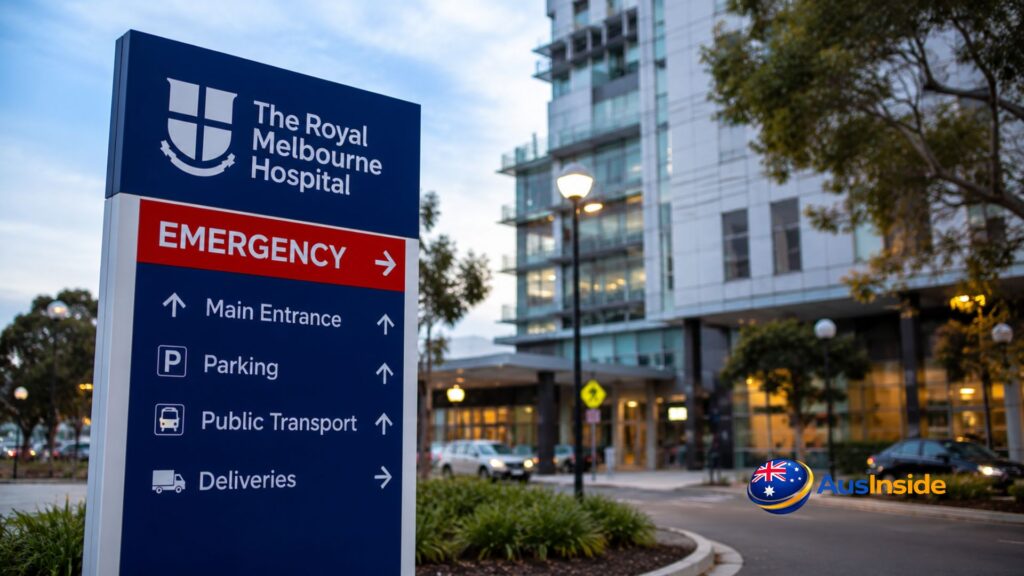
A genuinely common mistake: assuming “Royal Melbourne Hospital” refers to a single building. It doesn’t, and confusing the sites can mean showing up at an address with no emergency department when you actually needed one.
RMH Parkville — the main campus
- Address: 300 Grattan Street, Parkville, VIC 3050
- Phone: (03) 9342 7000
- Emergency care: Yes, 24/7
This is the site with the trauma centre, the helipad, and the emergency department. If someone says “I’m taking them to the RMH” in an emergency, this is almost always the place.
RMH Royal Park — recovery and rehabilitation
- Address: 34–54 Poplar Road, Parkville, VIC 3052
- Phone: (03) 8387 2000
- Emergency care: No
Focused on rehabilitation, aged care, and community-based services for people stepping down from acute care at the main hospital.
RMH Elizabeth Street — specialised outpatient care
- Address: 635 Elizabeth Street, Melbourne, VIC 3001
- Phone: (03) 9342 7000
- Emergency care: No
The newest site, focused on dialysis along with neuropsychiatry, neuroimmunology, and metabolic disease clinics. Most people have never heard of this one, which is exactly why it’s worth knowing — if you’re directed here for an appointment, you don’t want to be circling Grattan Street looking for it.
Beyond these three buildings, the RMH also delivers more than 50 services directly in the community and in people’s homes across Melbourne, regional Victoria, and interstate — so a home-visiting RMH nurse or therapist is a normal part of how the hospital operates, not an exception.
Visiting the RMH: Hours, Rules, and the Details That Trip People Up
| Detail | Information |
| General visiting hours | 10am–8pm daily |
| Rest period | 1:30pm–2:30pm |
| Visitors at the bedside | Two at a time during general hours |
| Emergency Department visitors | Welcome anytime, typically capped at 2 per patient |
| Check-in at entrances | No longer required |
| Access after 8pm | Via the Emergency Department, for designated visitors only |
A handful of wards run on entirely different rules — the Intensive Care Unit, Ward 6 South East, Ward 7 West, and the mental health wards in the John Cade building all set their own visiting hours and rest periods suited to their patients. Always check with ward staff directly rather than assuming the general window applies.
The rest period actually matters
Between 1:30pm and 2:30pm, lights dim and curtains close across most wards, and staff actively try to minimise noise. Showing up expecting a normal visit during this window and finding a darkened, quiet ward is a common source of confusion for first-time visitors. Designated visitors can usually stay through it if the patient wants them there; everyone else is generally asked to step out.
Designated visitors get real privileges
On admission, patients are typically asked to name two designated visitors. With the Nurse Unit Manager’s agreement, these people can help during mealtimes, be present for doctor visits, and stay outside the standard 10am–8pm window if needed. If you know you’ll be the main support person for someone admitted here, ask to be registered as a designated visitor as early as possible — it changes what you’re actually allowed to do later.
Masks haven’t disappeared entirely
Pandemic-era mask mandates have largely eased, but certain high-risk wards — Clinical Haematology, for instance — may still ask visitors to wear a surgical mask or N95. Masks are freely available at entrances and on wards regardless. The core guidance is simple: don’t visit if you’re unwell, have a cold or cough, or have recently tested positive for COVID-19.
Getting There: Parking, Transport, and the Things Google Maps Won’t Tell You
Parking at the main Parkville campus is genuinely tight, and it catches first-time drivers off guard more than almost any other detail in this guide.
- The car park is an underground facility shared with the neighbouring Melbourne Private Hospital, commercially managed rather than run directly by the RMH.
- Keep your ticket, payment typically happens before you leave, usually on Level 2.
- Disabled parking and a pick-up/drop-off zone are available on Level 2.
- A taxi rank sits on Grattan Street near the main entrance.
- Wheelchair drop-off is available at the rear entrance, near the underground car park driveway.
Tram routes run directly through the Parkville precinct, making them the most reliable way in if you want to skip the parking situation entirely. The precinct also connects to Melbourne Central station with a short tram or walk from there. The hospital’s own guidance leans toward public transport or taxis specifically because on-site and street parking is so limited — not a throwaway line, a genuinely practical recommendation.
All Research at the RMH: The Story Most Person Don’t Tell You
It’s tempting to think of a hospital purely as a treatment facility, but the RMH’s research arm is arguably just as important to its national reputation — and it’s almost completely absent from competing articles.
The infrastructure behind it
The RMH Research Foundation was created in 1994 to coordinate research activity hospital-wide. It evolved into the Melbourne Health Research Directorate in 2002, then became the Office for Research in 2008, which today manages research staff, grants, and ethics oversight across the institution.
How VIDRL became the centre of Australia’s COVID-19 response
This is the story almost nobody tells properly. The RMH took over general infectious diseases services from the closing Fairfield Hospital in June 1996, and the Victorian Infectious Diseases Service officially opened at the RMH on 7 February 1997. That infrastructure — built for a different era’s infectious threats — turned out to be exactly what Australia needed more than two decades later.
The hospital’s Victorian Infectious Diseases Reference Laboratory, VIDRL, operates as part of the Doherty Institute, sitting immediately next to the RMH. On 24 January 2020, a patient sample reached VIDRL. By 28 January, a team led by Dr Julian Druce and Dr Mike Catton had grown SARS-CoV-2 in cell culture — the first time the virus had been successfully cultured anywhere outside China. That breakthrough let laboratories worldwide validate diagnostic tests against an actual live virus sample rather than relying solely on genome data, and VIDRL shared its isolate with the World Health Organization and reference labs across Europe within days.
VIDRL also diagnosed Australia’s first confirmed COVID-19 case, on 25 January 2020, and at the pandemic’s peak was processing roughly thirty times the volume it considered a busy day pre-2020. None of this happened by accident — Dr Catton has pointed to the lab’s 2007 experience diagnosing a rare arenavirus through whole genome sequencing as part of what made the team ready to move that fast when COVID-19 arrived.
That single piece of context — a named lab, named scientists, an exact date, and a globally significant outcome — is the kind of detail that separates a hospital with “a research department” from a hospital that helped shape how the entire world responded to a pandemic.
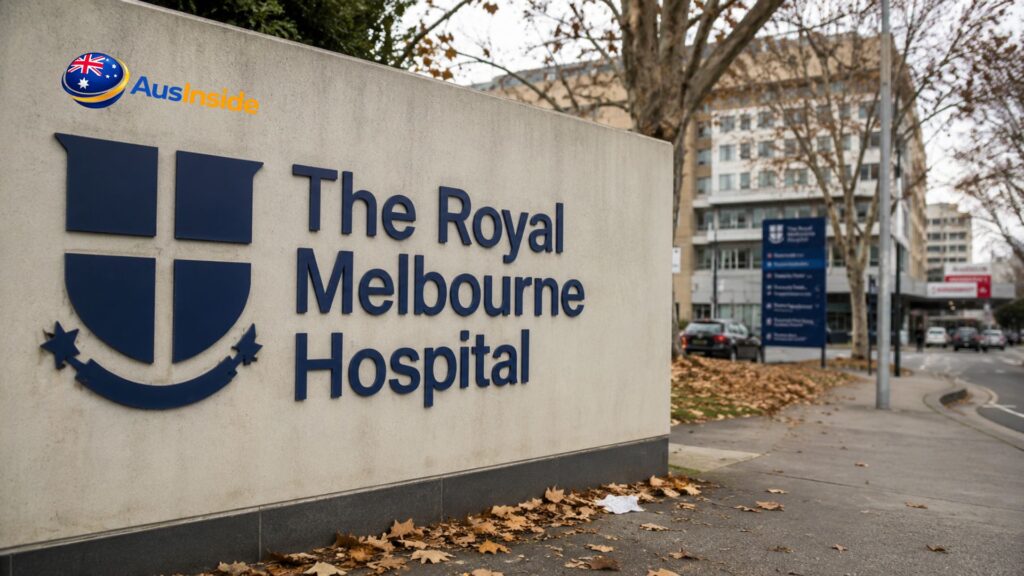
Mistakes People Commonly Make About the RMH
- Assuming it treats children or delivers babies. It doesn’t — both go to neighbouring specialist hospitals.
- Confusing RMH Parkville with RMH Royal Park. Only Parkville has an emergency department; showing up at Royal Park in an emergency wastes critical time.
- Arriving during the 1:30–2:30pm rest period expecting normal visiting conditions. Wards genuinely go quiet.
- Expecting free or easy street parking. Budget for paid parking, or use the tram network instead.
- Reading “Royal” as a sign of private, paid care. It’s a fully public hospital; “Royal” refers to its 1935 charter, nothing to do with funding.
- Not checking the live ED wait-time dashboard before driving in for a non-urgent issue. It exists specifically to help you make that call.
Don’t Forget To Read It: Bupa Visa Medical Centre
Key Takeaways
- The RMH opened in 1848 from a 10-bed cottage, predating Victoria as a colony by three years.
- It became “Royal” only in 1935, by Royal Charter, after operating for nearly 90 years under a plainer name.
- It’s one of just two adult Level 1 Major Trauma Centres in Victoria, treating roughly 5,000 trauma patients annually.
- A live, public ED wait-time dashboard now shows real-time estimates for non-urgent patients, a tool most visitors never realise exists.
- The hospital runs across three distinct sites — Parkville, Royal Park, and Elizabeth Street, each with a different purpose and only one offering emergency care.
- Its VIDRL laboratory was the first outside China to culture SARS-CoV-2, a breakthrough that directly shaped global COVID-19 testing in early 2020.
FAQs
Is the Royal Melbourne Hospital public or private?
Public. It’s funded through Medicare and Victoria’s public health system, with care free at the point of service for Medicare-eligible patients.
What’s the main address?
300 Grattan Street, Parkville, VIC 3050, on the corner of Royal Parade. This is the site with the emergency department.
Does it treat children or deliver babies?
No. The RMH is an adult general hospital. Paediatric and maternity patients are referred to the neighbouring Royal Children’s Hospital and Royal Women’s Hospital.
How can I check current ED wait times before going in?
The RMH publishes a live wait-time dashboard on its website, showing the estimated wait between triage assessment and seeing a doctor for non-urgent patients. It’s updated regularly throughout the day.
Is it a trauma centre?
Yes, one of only two adult Level 1 Major Trauma Centres in Victoria, alongside the Alfred Hospital, and the first in the state’s trauma system to gain that formal verification, in 2012.
Why is it called “Royal” if it opened in 1848?
It operated as plain “the Melbourne Hospital” for nearly 90 years before receiving its Royal Charter on 27 March 1935, which formally added “Royal” to the name.
Can I visit outside the standard 10am–8pm window?
Generally only if you’ve been registered as a designated visitor with the ward’s Nurse Unit Manager, or if you’re visiting someone in the Emergency Department, where visiting is allowed at any time.
Is parking available on-site?
Yes, but limited — an underground car park shared with the neighbouring Melbourne Private Hospital, commercially managed. Public transport, particularly the tram network through Parkville, is generally faster and easier.