
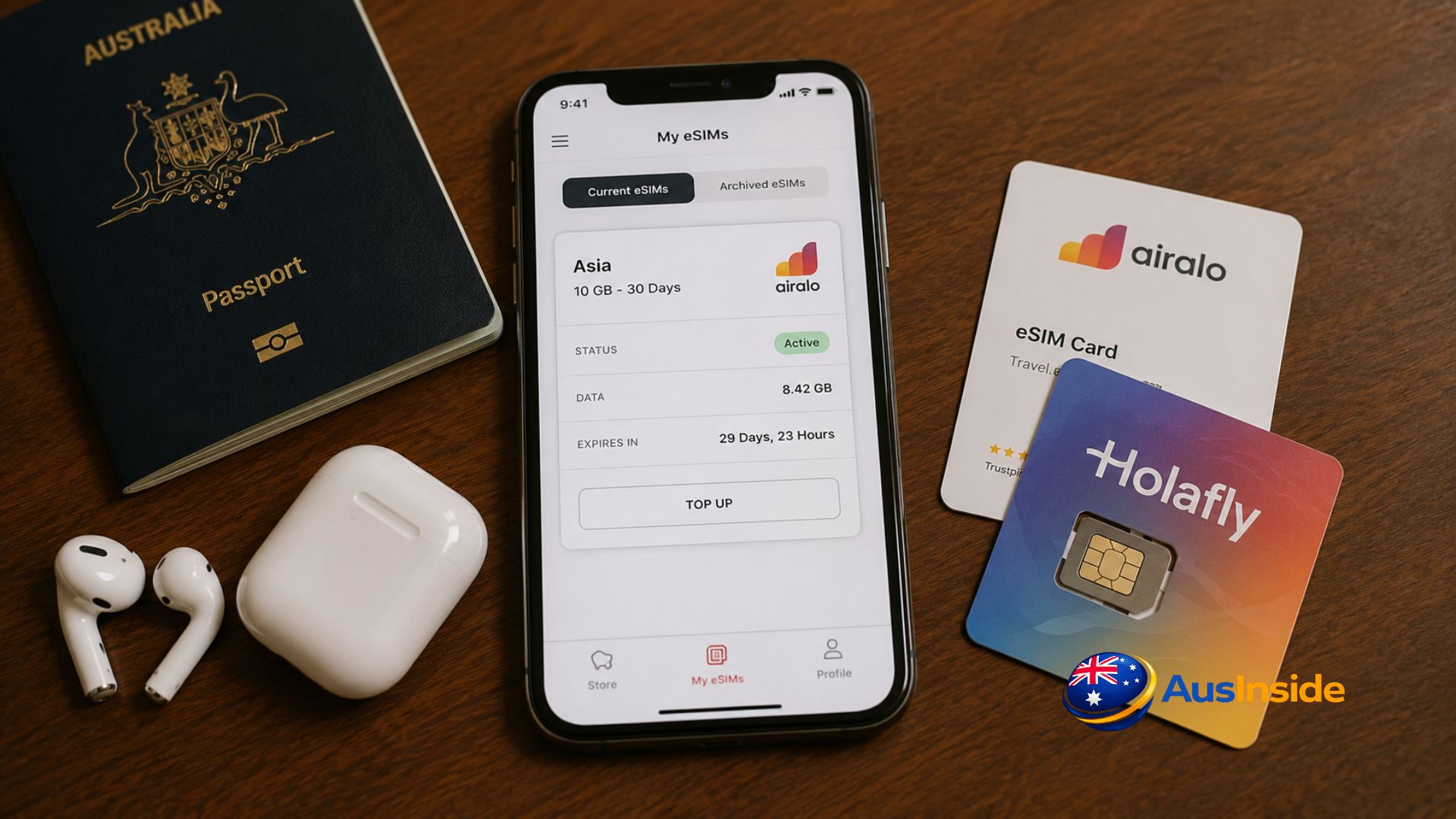
For most Aussie travellers, an eSIM from Airalo or Holafly bought before departure beats a physical SIM bought on arrival, it activates before you land, skips the airport queue, and costs less than Telstra or Optus roaming for anything longer than a couple of days. Our team cross-checked current pricing and entry requirements for Indonesia, Thailand, Vietnam, Japan, and Singapore in mid-2026, and the numbers below reflect what’s actually charged right now — a few of these countries have tightened their SIM registration rules recently, which changes the calculus.
This guide breaks down exactly what Best SIM Card for Travelling Asia in 2026, what documents you’ll need, and where each option falls short.
- Quick Answer: Our Top Picks for Aussie Travellers
- eSIM vs Physical SIM vs Telstra/Optus Roaming — What Actually Works
- How to Set Up Your Asia SIM Before You Fly
- Country-by-Country Breakdown
- How Much Data Do You Actually Need?
- Mistakes Aussie Travellers Keep Making
- Best SIM Card for Travelling Asia FAQs
Quick Answer: Our Top Picks for Aussie Travellers
| Provider | Type | Typical Cost (AUD)* | Data | Best For |
| Airalo Asia Regional eSIM | eSIM | ~$38 for 10GB (18 countries) | Multi-country bundle | Bali → Bangkok → KL style trips |
| Holafly | eSIM | ~$41/7 days unlimited (single country) | Unlimited (daily high-speed cap ~4.5GB) | Heavy streaming/social media users |
| Local carrier SIM (Telkomsel, AIS, Viettel, StarHub) | Physical | $4–$25 per trip | 10–100GB | Longest trips, cheapest per GB |
| Telstra International Day Pass | Roaming | $10/day (Zone 2) | 2GB/day | Short 2–4 day stopovers, higher-tier plans excluded |
| Optus Daily Roaming | Roaming | $5/day (Choice Plus plans only) | 5GB/day | Optus customers on eligible plans doing quick hops |
*USD/local currency converted to AUD at approximate mid-2026 rates; always check the provider’s site at checkout, since eSIM pricing shifts often.
Our take: eSIMs win on convenience for anything under 10 days. Local physical SIMs win on price per GB for longer stays, but several countries now require more paperwork than they used to — more on that below.
eSIM vs Physical SIM vs Telstra/Optus Roaming — What Actually Works
Why roaming only makes sense for short stopovers
Telstra’s International Day Pass gives you 2GB a day for $10 in Zone 2, which covers Thailand, Japan, Singapore, Malaysia, and Bali/Indonesia — but it’s only available if you’re on an eligible plan; customers on $129+ plans, leased plans, or Business Premium plans are pushed to pay-as-you-go rates instead, which run at roughly $3 per MB. Optus is cheaper on paper at $5/day for 5GB, but only for customers on Choice Plus plans — everyone else gets the $10/day Roaming Pass with just 1GB. Run a 10-day Bali-then-Bangkok trip through Telstra’s Zone 2 rate and you’re at $100 for 20GB total. The same 10 days on a regional Airalo eSIM (10GB, 18-country coverage) runs about $38 AUD. Roaming still makes sense if you’re only overseas for a day or two and don’t want to touch phone settings at all.
| Option | Setup Effort | Data Cost per GB | Local Number? | ID Required? |
| eSIM (Airalo/Holafly) | Low — install before flying | Low–medium | No (data-only plans) | Increasingly yes — Japan and Singapore now require passport ID even for data-only eSIMs |
| Physical local SIM | Medium — passport + sometimes IMEI registration | Lowest per GB | Yes | Yes, passport in every country covered here |
| Telstra/Optus roaming | None | Highest | Yes (your Aussie number) | No, uses existing account |
How to Set Up Your Asia SIM Before You Fly
- Check your phone supports eSIM. iPhone XS onward and most Samsung Galaxy S20+ models do. Older or budget phones may need a physical SIM instead.
- Have your passport ready before you buy, even for a data-only eSIM. Indonesia, Thailand, Vietnam, Japan, and Singapore all now legally require ID verification for prepaid mobile data, physical or digital — this isn’t optional paperwork some travellers skip anymore.
- Buy the eSIM at least 24 hours before departure through the Airalo or Holafly app — you need Wi-Fi to download the profile, not to activate it.
- Install but don’t activate yet. Go to Settings > Mobile Data > Add eSIM, install the profile, but leave data roaming off until you land.
- Keep your Aussie SIM as your primary line for SMS-based bank verification codes — a lot of Aussie banks still send OTPs via SMS, and a data-only eSIM won’t receive them.
- Turn on the eSIM data line the moment you land, and switch off data roaming on your original Telstra/Optus/Vodafone SIM to avoid accidental roaming charges — Telstra’s Day Pass activates automatically the moment your phone touches a network overseas, so this step matters even if you never intend to use it.
- If staying over 10 days in one country, buy a local physical SIM at an official carrier counter once you land — it’s cheaper long-term per GB, though you’ll need your physical passport in hand at the counter, not a photo of it.
- Save key contacts on WhatsApp before you leave, since messaging apps work over any data connection regardless of which SIM is active.
Country-by-Country Breakdown
Bali & Indonesia
Telkomsel is the most reliable network outside Denpasar and Ubud — coverage drops off fast in more remote parts of Nusa Penida or Flores. Its Tourist Prepaid Card runs about IDR 150,000 (roughly $15 AUD) for 25GB over 30 days, sold at GraPARI stores and airport counters at Ngurah Rai. A new 2026 rule (Ministerial Regulation No. 7 of 2026) means every SIM is now distributed inactive and only switched on after your passport is checked — foreign visitors are capped at three SIMs per passport per operator. If you’re staying over 90 days, you also need to register your phone’s IMEI with Indonesian Customs via the Mobile BeaCukai app or the airport desk, or your handset loses network access after the 90-day mark.
Thailand
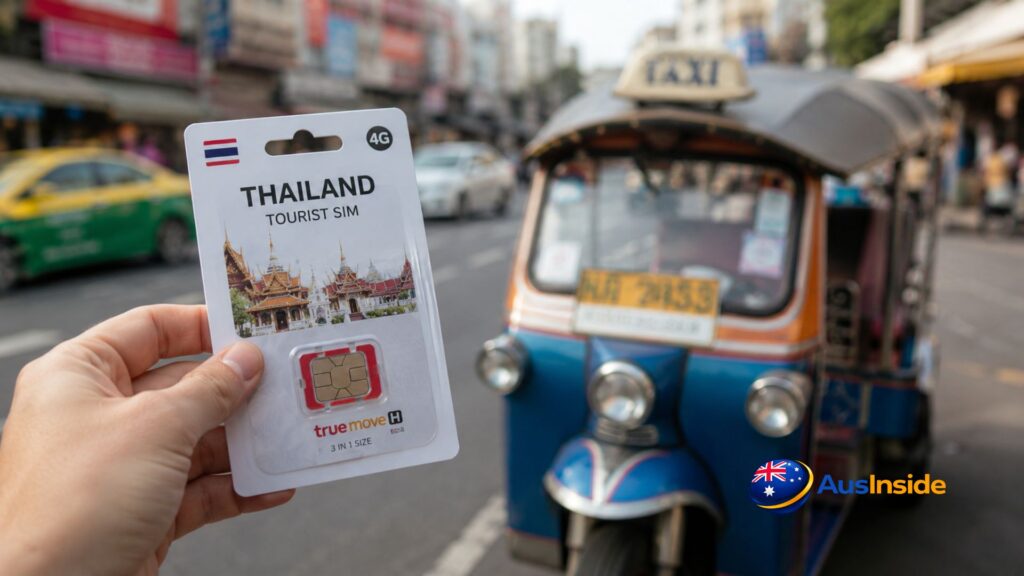
AIS, True, and dtac all cover Bangkok, Phuket, and Chiang Mai well, with AIS holding a slight edge in remote areas. Tourist SIM packs run roughly THB 399–1,699 (about $17–$70 AUD) depending on data and validity, sold at official counters in the arrivals halls at Suvarnabhumi and Don Mueang — stick to the branded AIS/True/dtac kiosks, since unbranded airport vendors have been known to charge three to four times the standard rate for the same plan. Thai law caps foreigners at five SIM cards per operator, and under NBTC rules, any registered number that isn’t activated within 60 days needs your passport re-verified before it’ll connect.
Vietnam
Viettel has by far the widest rural coverage, reaching an estimated 95%+ of the country including mountain routes like Ha Giang and Sapa, which matters if you’re doing the Hanoi-to-Ho-Chi-Minh road route through Da Nang and Hoi An. A Viettel tourist SIM runs from around VND 60,000–180,000 (roughly $4–$11 AUD) for 7–30 days. Vietnamese law requires every SIM to be registered against a passport with a photo taken at the point of sale — if a vendor hands you a SIM without asking for your passport, treat it as a red flag; unregistered “ghost” SIMs get cut off by the network without warning.
Japan
Japan tightened its rules in 2026 — since April 1, the Ministry of Internal Affairs and Communications has required passport or residence card ID for every SIM and eSIM purchase, including data-only tourist plans, closing a loophole that used to let some eSIMs activate with no ID at all. NTT Docomo itself only sells direct to residents with a residency card, so tourist options run through resellers like Sakura Mobile, Mobal, or IIJmio Tourist, which piggyback on the docomo or SoftBank networks and accept a passport instead. A 10GB / 2-week plan through one of these resellers runs roughly $25–$35 AUD, with coverage that holds up well even in rural areas like the Japanese Alps.
Singapore (Regional Hub)
Singapore’s regulator, IMDA, requires passport registration for every prepaid SIM, physical or eSIM — no local address needed, but the physical passport must be presented, not a photo. StarHub’s cheapest tourist SIM starts at SGD $12 (about $14 AUD) for 100GB over 10–30 days, while Singtel’s tiers run from SGD $12 up to SGD $50 (about $60 AUD) with extra roaming data bundled in for nearby Malaysia, Indonesia, and Thailand. Buying in the city rather than at Changi saves real money — the same Singtel SIM that’s SGD $70 at the airport counter is roughly SGD $30 from an Orchard Road store. Because Singapore is often a stopover rather than the main destination, we generally just run a regional Airalo eSIM through the layover instead of buying local.
How Much Data Do You Actually Need?
| Traveller Type | Daily Usage | Recommended Plan Size (per week) |
| Backpacker (maps, messaging, occasional social media) | 0.5–1GB | 5–7GB |
| Digital nomad (video calls, cloud work, streaming) | 3–5GB | 20–30GB |
| Family on holiday (navigation, photo backup, kids’ devices) | 2–4GB per device | 15–20GB per device |
| Business traveller (email, VPN, video conferencing) | 2–3GB | 15GB |
Mistakes Aussie Travellers Keep Making
- Activating the eSIM data line before leaving Australia, burning through the allowance on home Wi-Fi calls before the trip even starts.
- Assuming a data-only eSIM skips ID checks in every country — as of 2026, Japan and Singapore both require passport verification even for data-only plans, closing what used to be a genuine loophole.
- Assuming Telstra’s Day Pass zones cover every Asian country at the same rate — it doesn’t, and customers on $129+ or Business Premium plans aren’t eligible for the Day Pass at all, defaulting instead to pay-as-you-go rates around $3/MB.
- Buying a SIM from an unbranded street vendor instead of an official carrier counter — a common issue near airports in Bangkok and Ho Chi Minh City, where unregistered “ghost” SIMs get deactivated without warning.
- Not disabling data roaming on the primary Aussie SIM, leading to surprise charges even with an active eSIM installed.
- Registering an Indonesian SIM and then losing network access after 90 days because the phone’s IMEI was never registered with Customs — an easy step to forget on a longer trip.
Best SIM Card for Travelling Asia FAQs
Do I need a physical SIM if my phone supports eSIM?
No, unless you’re staying in one country for more than 10 days, where a local carrier SIM works out cheaper per GB, or you specifically want a local phone number for ride-share apps and bookings.
Can I use my Australian number for SMS verification while on an Asia eSIM?
Yes, if you keep your original Telstra, Optus, or Vodafone SIM installed alongside the eSIM and only disable its data roaming, not the SIM itself.
Is it cheaper to buy an eSIM before leaving or a physical SIM on arrival?
For trips under 10 days, the eSIM is usually cheaper once you account for wasted time queuing at arrivals. For longer single-country stays, a local physical SIM wins on price per GB — provided you’re across each country’s current passport and registration rules before you land.
Will one SIM work across multiple Asian countries?
Regional eSIM bundles from Airalo cover multiple countries under one plan (its Asia regional plan spans 18 countries), which suits multi-stop trips like Bali–Bangkok–Kuala Lumpur. Physical SIMs are generally country-specific.
Do I really need my passport for a data-only eSIM now?
Increasingly, yes. Japan’s Ministry of Internal Affairs and Communications began requiring ID for every SIM and eSIM purchase, including data-only tourist plans, from April 2026. Singapore’s IMDA has a similar blanket requirement. Always have your passport on hand when buying data for Asia, even if you’re not expecting to need it.